
⏱ ~5 min reading
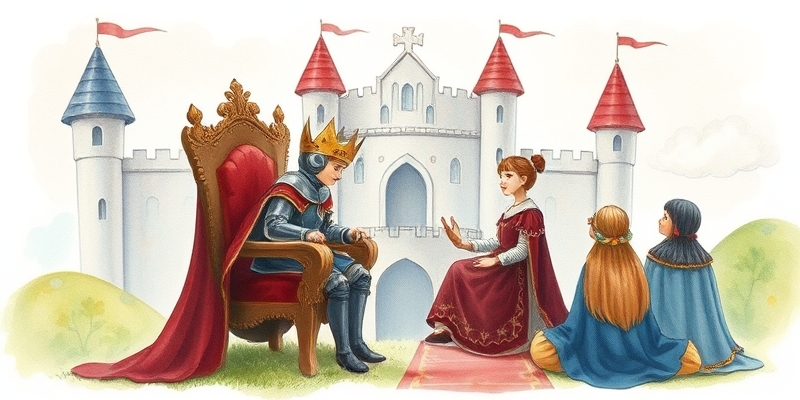
In a castle that stood on a high hill above a river, there lived a little king. His name was Artem. He had just turned eight when a crown was placed on his head - a large, golden one, with rubies on the rim. The crown was so heavy that Artem had to put a soft velvet strip inside it so that it wouldn't slide down his ears.
The crown came to him unexpectedly. His father, the king, died in the fall - quietly, in his sleep, after a long illness. The castle smelled for a long time of the herbs with which he was treated, and of soft wax candles. Artem cried, laying his head on his father's pillow, which still retained his scent. And then he wiped his tears and said to himself: "Now I must be strong. For two.".
The coronation was quiet. A priest in a silver robe placed a crown on the boy. The knights tapped their swords on the stone floor. The great hall smelled of incense and warm wax. Artyom sat on a throne, his feet barely touching the floor, and looked at his people very seriously.
After the coronation, regents gathered around him—three elderly gentlemen in long fur coats. They were to rule for him until he grew up.
"Don't worry, Your Grace," said the eldest of them, Mr. Bogdan. "You are still young. We will decide everything ourselves. You just sit on the throne and smile.".
Artem looked at him for a long time. Then he said quietly:
— I am small. But I have a big heart. And I want to listen.
The regents looked at each other and smiled indulgently. They said, "What can you do with a child?".
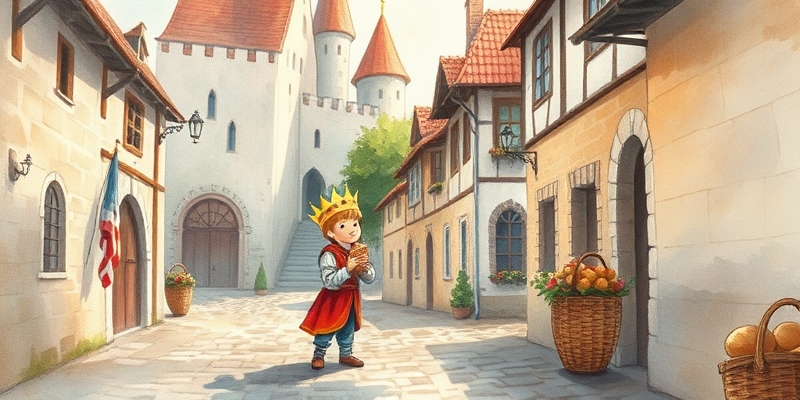
But Artem did not sit idly by. The very next morning he asked to saddle a small bay horse named Gorik and rode to the nearest village. Gorik stepped carefully along the stone road - kok-kok-kok - while Artem looked around and absorbed everything: the smell of smoke from the chimneys, the warm smell of bread from the bakery, the lowing of cows behind the fences.
In the village he dismounted, adjusted his crown, which had come off again, and walked down the street. He passed by the vegetable gardens, the orchards, the grandmothers who were threshing flax. He bowed to everyone. He asked:
"Grandma, what do you need? What hurts?"
The old woman with the flax didn't understand at first. She looked at the boy with the crown, then at the little bay horse, and couldn't believe her eyes.
"You are the king, aren't you, swallow?"
"The king, grandmother. Tell me not to be afraid.".
The grandmother sighed and told him. That the bridge over the river had broken, and the grandson now went to school across a ford—and it was cold in the winter. That the salt tax was high, and people no longer salted cabbage properly. That the widowed daughter couldn't send her little ones to school because she didn't have shoes.
Artem listened. He didn't interrupt. He just nodded and memorized.
In every village it was the same. He went to the bakers and asked if there was enough flour. To the fishermen - if the fish was good. To the small children - if their dinner was delicious. Some laughed at him, some were moved to tears. And the children ran after the horse and threw wild flowers into Nut's mane.
When Artem returned to the castle in the evening, the regents were already waiting in the hall - angry as autumn clouds.
"Your Grace," said Mr. Bogdan sternly, "the king does not ask common people. The king orders.".
Artem took off his crown, placed it on the table—it clinked gold against the wood—and looked the gentleman straight in the eyes.
“How would I know what to order if I didn’t ask?” he asked quietly.
The regents opened their mouths and found nothing to say.
From that day on, Artem ruled in his own way. He reduced the salt tax — and cabbage became tasty again throughout the kingdom. He repaired the bridge across the river — and it became easier for children to go to school. He built three new schools — in remote villages where students used to walk ten miles. He bought shoes for widows whose children had no way to leave their homes. And he did one special thing: once a week, he ordered the castle gates to be opened so that anyone who wanted could come and have their say to the king.
People came. They told about both great troubles and small joys. Artem sat on the throne with a notebook and wrote down, wrote down. Sometimes the crown would slide down to his eyebrows, and he would laugh along with those who came.
So a year passed. Another passed. Ten passed.
The kingdom prospered. Grain carts rolled along the roads, children's voices rang in the schools, and quiet evening psalms were sung in the churches. Neighboring countries envied. Ambassadors came and asked:
— How did you manage to do that?
And the residents simply replied:
— Our king listens to us.
Artem ruled until he was old. His beard had become white as fresh snow, and the crown—the same one from childhood—was already firmly in place and would not come off. When his son, young Nikolai, was to inherit the throne, Artem summoned him to him and presented him not with a crown. Not a sword. Not a seal.
A notebook. Old, worn, tied with a leather cord.
“Dad, what is this?” asked Mykola.
"This is my greatest weapon," Artyom said quietly. "Everything I've heard from people over the past fifty years is recorded here. Listen to them, son. These are your people. And this is your strength.".
Mykola took the book and held it to his heart. Artem looked out the window — where the stars were already shining above the roofs of the castle, like candles on an altar — and smiled softly.
Because he knew: his heart was as big as it was, and it remained so. And the crown is only gold. The main thing is to listen.
✨ The king's greatest weapon is the ability to listen to people ✨