
⏱ ~5 min reading
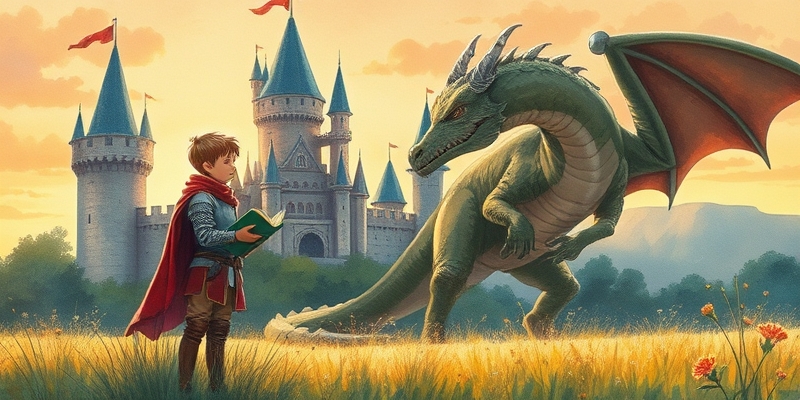
In the kingdom of Green Vale there lived a young knight. His name was Timko. He was tall, thin, with curly dark hair and very attentive eyes. He wore a simple knight's jacket made of leather, boots with buckles and a belt. But on the belt where other knights had a sword hanging, Timko had another object hanging - a small leather notebook and a thin pencil on a string.
Because Timko wrote poetry.
Every morning, when the first swallows were just flying over the castle, and the dew on the stone walls glittered like silver beads, Timko would go out onto the wall. He would lean his elbows on the cold stone, look down — at the river, the wheat field, the forest — and write down what he heard with his heart. About how the world wakes up. About how lilacs smell after the rain. About how the old watchdog sighs in his sleep.
The other knights laughed.
"Timko-Timko," they shouted, passing by him with swords on their shoulders. "Where is your sword? How will you fight?"
"I won't fight," Tymko replied calmly. "I'll listen.".
"What if a dragon comes?"
"Then we'll talk to him.".
The knights laughed and went on - to the tournament, to training, to a duel with a wooden pole. And Tymko returned to his notebook. He was not offended. His heart was quiet, as it became evening.
Then one summer day, the sky over the kingdom suddenly darkened. Not from clouds. From wings. Giant, leathery, with green scales. A dragon flew into the valley.
He was huge - like two houses put together. With blue smoke from his nostrils and eyes the color of wet gold. He sat down on the hill near the castle and sighed heavily. From that sigh the windows trembled, and the horses in the stable pricked up their ears.
The king rang the great brass bell. The knights lined up in the courtyard, in mail, helmets, swords, and spears. The banners fluttered in the wind, the torches smoked. The whole kingdom held its breath.
The first knight stepped forward, Lord Gordius, the strongest of them all. He stood before the dragon and swung his sword.
The dragon merely twisted its jaws and puffed out warm fire. Not evil, not scary. It just puffed out. Mr. Gordius' sword was scorched as if it had just been pulled from the furnace. The knight dropped it and stepped back.
The second knight came out. And the third. And the fourth. They all went back, with scorched shields and singed eyebrows. The dragon didn't kill anyone. It just puffed fire and looked sadly and sadly. That's how a dog looks when it hasn't been allowed into the house for a long time.
The king looked at the knights and didn't know what to do. And then from the very end of the row came Timko. Without a sword. Without a shield. Without a helmet. Only with a notebook in his hand.
“Your Majesty,” he said quietly, “allow me.”.
"Tymka, you're going to get burned," the king was worried. "You don't even have a coat of mail.".
"I know," Timko nodded. "But it seems to me that this dragon is not waiting for fire.".
Timko slowly walked through the yard, over the drawbridge, across the green field to where the dragon sat on the hill. The knights watched from the wall and held their breath. Timko stopped five steps from the large scaly paw. He raised his head. He looked the dragon in the eye.
The dragon lowered its mouth lower. He exhaled. The hair on Timko's cheeks moved from that warm breath. But the knight did not back down.
"I brought you a poem," said Tymko quietly, as one speaks to a sick child. "May I read it to you?"
The dragon blinked its large golden eyes. And nodded faintly.
Timko opened his small leather notebook. He flipped through a few pages. He found the one he needed.
He read about loneliness. About what it's like to be big, strong, with leathery wings, but have no one to fly into the sunset with. About how quiet it is at night above the mountains, and no one to speak to. About how you wish someone wouldn't be afraid of your fire and would just sit next to you.
Timko's voice wasn't loud, but the words fell as easily as apple tree petals.
The dragon listened. At first, he was still. Then his big eye flashed. A big, big tear rolled down his face—one you could wash in. It fell onto the grass and turned into a small puddle.
"You guessed it," said the dragon. His voice was low, like thunder behind the mountains. "I didn't come here to fight. I came so that at least someone would understand me. A hundred years over the sea, alone. A hundred years without a word.".
"Now I'm not alone," said Timko and placed his hand on the scaly paw. The scales were warm, like a home stove in winter. "Now you're my friend.".
The dragon lowered his head so low that he rested it on Timko's shoulder. And he panted softly, like a cat by the stove.
The king from the castle saw all this. He took off his helmet, handed it to his squire, and walked across the bridge alone, unaccompanied. He approached and bowed to the dragon as his equal. And he placed the highest order of the kingdom on Tymkov's shoulders - a gold one with a green emerald.
"You are the best knight I have ever known," said the king. "Without a sword. But with the biggest heart.".
The dragon stayed to live in the mountains near the kingdom. Timko flew to him on his back every Sunday, and together they watched the sun set behind the distant ridge. Timko read new poems to the dragon, and the dragon suggested rhymes with a low hum.
And the other knights—the ones who had laughed before—little by little stopped mocking. Some even asked Timko for a pencil and began to write something down on their free evenings.
Because they understood a simple thing: true knightly courage is when you go forward without weapons, only with a good heart. And a word spoken with such a heart is more powerful than any sword in the world.
✨ A word spoken with a kind heart is mightier than any sword ✨