
⏱ ~6 min reading
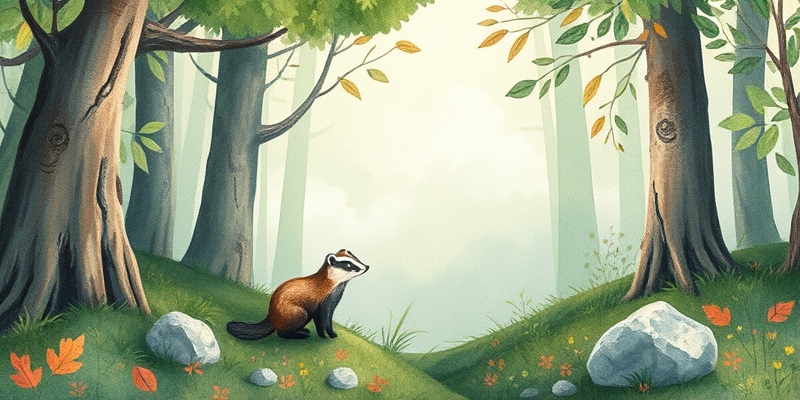
Deep in the old forest, where a path hides between the roots of a large ash tree, there was a tiny hole. From the outside, nothing special. An earthen passage between the roots, a few ferns at the entrance, moss on the old stones. But if you lean in and go inside, being careful not to hit your head on the low ceiling, you find yourself in a real forest museum.
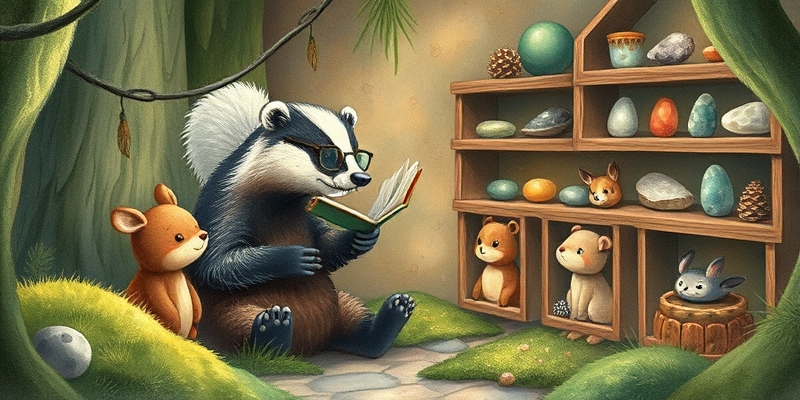
Everything there was small and ancient. Along the walls was a shelf of bark, smoothed by paws. On the shelves were pebbles. One was gray, with a vein. One was white, like a lump of snow. One had a hole in the middle, through it. Around the pebbles were leaves, dried and laid out evenly. Yellow, red, brown, silver—the whole of autumn in miniature. Next to them were feathers. White, black, mottled, with a blue stripe. Hanging on a thin thread were acorns, pine cones, and an old rose petal.
The master of all this was an old badger. His name was Archive.
The archivist was gray-haired, with white glasses, and wore round glasses made of dried currant bark. He walked slowly, for he was quite old. He was kind, and his voice was soft. And his memory was like a whole library.
Every week, the forest children came to him. Bunnies with whiskers that had just started to turn white in the winter. Hedgehogs, still very small, with soft needles. Squirrels with fluffy tails. Little foxes with interesting noses. They all sat in a circle on the fresh moss, and the Archive began.
"What should we tell you today?" he adjusted his glasses. "Ah, here's a pretty one. Here's this stone.".
He picked up a gray pebble with a vein in his paws. He held it carefully, like a testicle.
"This stone, my children, lay by the old spring. A hundred years, no less. Those who came here to fetch water would place clay cups on it. Kings too, and peasants too. Because the water gives everyone a drink equally, it refuses no one. Once upon a time, a boy sat on this stone, who later became a hunter and always brought a piece of bread to the forest animals. His mother baked it for him. He remembered that the forest fed him and shared it.".
The bunnies listened with bated breath. The smallest bunny sat closest to the Archive and nodded at every word, as if it understood everything.
“And this?” asked the hedgehog, poking the bluish feathers with his needle.
— Oh, this is special, — smiled Arkhiv. — These are the feathers of the first bird that returned to our forest after a long, long winter. The winter was such that even the old oaks thought — well, it's over, we won't survive. The snow lay for months. The clouds were gray-gray. And one morning — phrr! — a bird flew in. Small, blue-breasted. It sat on a branch and sang. And we understood — spring would come. It brought hope. That's why I kept these feathers. So that everyone would remember: after the longest winter, spring always returns.
The squirrels gasped softly. The fox cubs reached for the feathers with their noses - carefully, without touching them.
“And this leaf?” asked the smallest squirrel.
The archivist picked up a reddish leaf with an uneven edge. It was almost transparent, thin as snow.
— This leaf is from the oldest tree in the forest. It stands on a slope, next to a beaver dam. Once upon a time, a terrible storm passed over the forest. The wind broke the spruce trees like matches. And this tree stood. It bent - but it stood. It lost half of its branches, but the root held. And in the spring it turned green again. This leaf is from it. It knows what resilience is. How to stand when it's hard. How to bend - and not break.
The fox narrowed his eyes.
— And my mother taught me that bending is weak.
"Not quite, little one," said the Archive gently. "Bending is wise. A tree that bends does not break. But that which stands straight and firm, without any movement, is the first to break. Sometimes you have to be soft to stay whole.".
The children thought for a moment. The old badger adjusted his glasses.
— Now listen to the most important thing, my little ones. Why am I collecting this? Not because I love old things. But because the past is our strength. Without memory, we would be like the wind. Have you ever heard the wind? It runs, makes noise, hums, pushes leaves — but it never has a house or roots. It is nowhere. Because it doesn't remember anything. And we are different. We remember where we were born, who fed us, who taught us. And that's why we are here. Deep, like the roots of an old oak.
The bunny raised its ear.
"What if I forget?"
"Then we must come to the one who remembers," smiled the Archive. "And listen. That's why we have museums. That's why we have grandmothers. That's why we have the forest—it remembers everything.".
The wind rustled outside the mink window. A few yellow leaves peeked through the entrance. The archivist stood up, croaking, chose the most secret leaf and put it on the shelf. And so his collection grew every day.
Over time, Arkhiv became very old. So old that his glasses were already falling off his nose, because his nose had shrunk a little with age. And then he began to look closely at all the children who came to listen.
One little badger had been visiting him since he was a little boy. He always sat in the front row. He listened silently, never interrupted. He memorized everything. His name was Korinchik.
One day, the Archive called Korinchyk to itself.
"Kid," he said quietly, "you've been coming here for years. Tell me, do you remember where this gray stone came from?"
"I remember," Korinchyk nodded. "From the old spring. Kings and peasants drank from it.".
— Are these feathers?
"The first bird after a long winter. It brought hope.".
— And this leaf?
"From the oldest tree. That knows how to bend and not break.".
The archivist adjusted his glasses, which were sliding down his nose. His eyes became wet, like those of a happy grandfather who has found his grandson.
"That's all right, kid," he whispered. "Now it's all up to you.".
When the Archive went far, far away — to where all old badgers go after a long life — Korinchyk sat down in his place. He adjusted his glasses (his, made of thin alder). And when the children came in the morning, he began:
"What should we tell you today? Ah, here it is, pretty. Here is this stone..."
This is how memory does not disappear. This is how the forest remembers itself. Because there is always someone who listens more attentively than anyone else. And everything is passed on to him - like the light of a candle passes to another candle, and both then shine.
And the small museum between the roots of the ash tree still stands. Whoever walks along the path should lean in. Suddenly, they will be lucky enough to hear another story.
✨ Memory is the root without which we would be like the wind, without a home ✨