
⏱ ~6 min reading
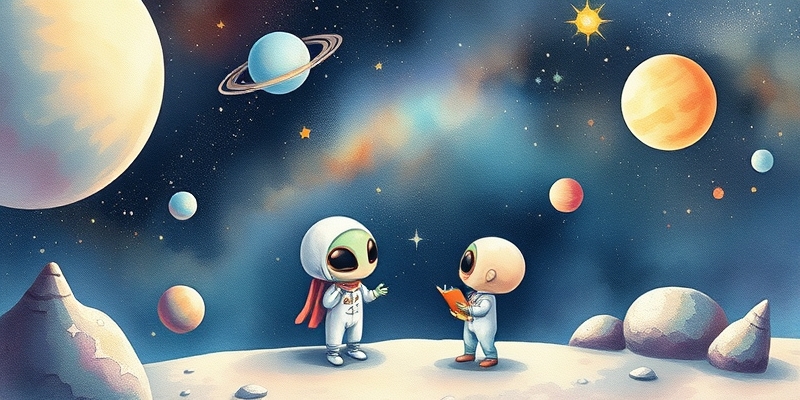
If one evening you look up at the sky and notice a small star that quietly twinkles a little differently than the others — evenly, in one beat, like a window with a lamp burning in it — then know: it's not a star. It's a space school.
It is built of the thinnest star glass. Its walls are transparent, like the morning air. The desks float in weightlessness, and instead of a bell, a small bell made of crystal droplets rings. Little aliens study at the school. Blue, pink, with antennae, with delicate wings, with three eyes and one. All are different. All are kind.
Their teacher is Madame Tumanka. She is big, soft, like a cloud with a diaper story inside. Her voice is very quiet. When she tells a lesson, even the most restless newcomer calms down and listens, putting his head on his paws.
This school teaches special things. Not just math, but how to multiply galaxies. Not just drawing, but how to draw nebulae with watercolor fingers so they don't blur. Not just housekeeping, but how to make a bed of stardust so you have especially good dreams at night.
There are twelve students in the class. And the best one is Yasyk.
Yasik was a little alien with soft green skin, two antennae that wiggled when he was happy, and eyes that looked like two drops of dew. He wasn't the smartest in the class. He wasn't the fastest. He wasn't the first to solve a problem.
But Jasyk knew something different.
He knew how to listen to silence. He sat at his desk, closed his eyes, and heard the distant Moon whispering to its daughters, its little satellite moons. He heard the old comet sigh, tired of its journey. He heard the desks whispering to each other when there was no one in the classroom.
This skill is rare. Not all newcomers have it. But Madame Tumanka said: "He who hears silence understands words.".
One day there was a test at school. The young teacher, Mr. Meteoric - he had just started teaching - had prepared problems. Difficult, very difficult. Multiply the Milky Way by the Andromeda Nebula. Divide the ring of Saturn into seven equal parts so that each one knew its own task. Make a list of all the names of the stars in the constellation Cygnus.
When Mr. Meteor handed out the papers, the class became very quiet. The aliens bowed their heads. One little pink student, named Fluffy, immediately blew his nose - he didn't know where to start. Another, little blue Liu-Liu, scratched the back of his head with both antennae. The third, an alien girl with three pigtails, quietly cried: the letters blurred before her eyes.
Jasyk looked at his piece of paper. He looked at his classmates. And he realized: he already knew what to do.
He slowly, without noise, flew up to Pushko.
"Hey," he whispered. "Don't cry. Look. The Milky Way is long, like a ribbon. And the Andromeda Nebula is round. Imagine that you wrap a ribbon around a round apple. The number of times you wrap it is the same.".
The little fluff raised its head. Its eyes sparkled—once, twice.
"Ah!" he whispered. "I understand!"
"Don't copy anything from me," Yasyk added gently. "Write it yourself. You understood it yourself. It's yours now.".
Then Yasik flew up to Liu-Liu. He told me about Saturn's ring - how it is divided. He didn't give a ready answer - he explained step by step, until Liu-Liu himself said: "Yeah, I see!" Then - to the alien girl. He just sat next to her until her tears dried. And then he showed me how to write down the names of the stars not all at once, but two or three at a time, and mark every two or three with a small cloud. It's not that scary.
Yasyk walked from desk to desk. Quietly. Not loudly. He explained to each person in his own way. Some needed a comparison. Some needed an example. Some just needed someone to be around.
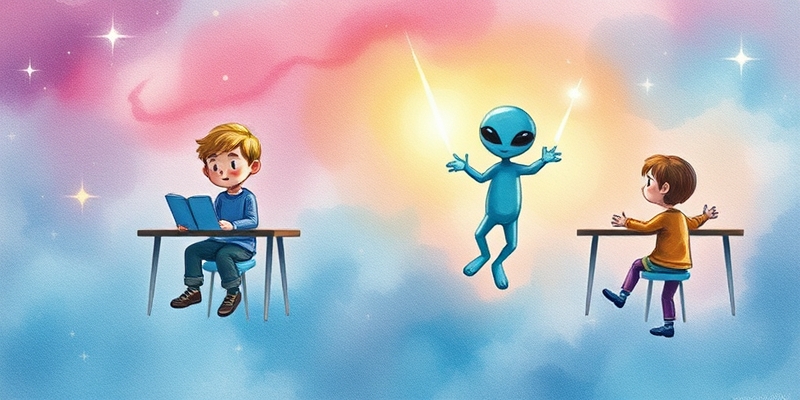
When he returned to his desk, his piece of paper was still unfinished. There was not enough time.
The bell rang. Mr. Meteor gathered the leaves. He sat for a long time, checking them. The class was quiet.
And then Madame Tumanka came in. She didn't say anything. She just looked at Mr. Meteor with a soft gaze. He nodded. And began to announce the grades.
When he reached Yasyk, he stopped. He looked at him. And said:
— Yasik. You didn't answer all the questions. But I'll give you ten.
The class fell silent.
"For what?" Jasyk was surprised. His antennae froze.
"For your kindness," replied Mr. Meteor. "And for teaching others. I saw you going from desk to desk. How you wouldn't let them copy. How you explained until they understood. This is the most difficult of all sciences. It's more than multiplying galaxies.".
Madame Fog nodded.
"Because wisdom, child," she said gently, "is not just knowledge. It is the ability to share it with friends. The knowledge you have alone is like one candle. And the knowledge you share is like a whole flashlight. It shines on.".
The red-and-green Yasik sat at his desk. He felt ashamed and happy at the same time. He didn't know what to say.
And his classmates took turns approaching him and hugging him — some with their wings, some with their antennae, some just with their cheeks. The little fluff rolled over the hardest and muttered:
— Thank you, Yasyk. Now I can do it myself.
From that day on, Jasyk understood an important thing. True appreciation is not for knowledge. But for the heart. And the best student is not the one who knows everything himself. But the one along with whom others are also beginning to know.
He began to share even more generously. He helped out during breaks. He mended broken desks. He told the little ones how to make a bed of stardust — quietly, without haste.
They say he still studies at the same school. He will be a grown-up, but he is still a student. Because wise newcomers know: you have to learn all your life. And sharing takes even longer.
If you ever see that little star twinkling steadily in the evening, nod to it. Perhaps at this very moment, inside, Yasik is helping someone solve a problem. Quietly. In his own way. In a kind way.
✨ True appreciation is not for knowledge, but for the heart ✨