
⏱ ~6 min reading
In a small village hidden among willows and wheat fields, there lived a boy. His name was Stepanko. He was seven years old, he had freckles on his nose, two gaps instead of his two front teeth, and a big, big dream: to see the sea.
But the sea was far away. Beyond the mountains, beyond the forests, beyond the big cities. Stepanko knew about it only from the pictures in the book: blue-blue water, seagulls, dolphins, rocky shores. Dad promised that someday they would definitely go. But for now — only pictures.
But a river flowed through the village. Small, but lively. It started somewhere in the mountains and ran, ran, ran until it flowed, as my grandmother said, into a large river, and that into a canal, and the canal into the very sea.
One warm summer evening, when the sun turned the water pink, Stepanko sat on a bridge across the river. He held a sheet of white paper in his hands. Dad taught him how to build boats—real ones, with a sharp nose, high sides, and a triangular sail. Stepanko built one like that. The best one. By himself.
He held the boat in his hand for a long time. Then he leaned over the water and whispered:
"Listen, little boat. You won't stay here. You'll sail where I can't. To the sea. Do you understand? Look at everything there for me. Remember. And I'll wait for you.".
The ship was silent. Only the paper rustled softly in the light wind.
Stepanko carefully lowered it into the water. The boat rocked, turned its nose downstream — and swam away. Slowly at first. Then faster. A small white speck in the dark water. Stepanko stood on the bridge until the boat disappeared around the bend.
"Have a safe journey," he whispered.
And the boat sailed. Oh, how far it sailed!
The first day — under the willows. The cows came to the watering hole, looked at it in surprise — what was that white thing in the waves? The boat wasn't offended. It just floated.
The second day - we passed a large mill. The wheels splashed with water, and the miller's window smelled of fresh bread. The boat was a little scared of the large wheels, but it slipped past and sailed on.
The third day — through the city. Tall buildings were reflected in the water like upturned candles. People were walking on the bridge above it, trams were rumbling, someone dropped a red apple into the river from above — it gurgled next to the boat, swayed like a wave and sailed on. The boat was amazed: the world is big, so big! It smelled of street bread, gasoline and something sweet — as if ice cream was being sold somewhere nearby.
Through the window of one of the houses, a girl saw him, leaned forward and shouted in delight:
"Mom, look! A little boat is sailing on a long journey!"
The ship heard this too. It felt warm from that little voice. It thought: «I am not alone. They see me. They are happy for me.» And it sailed even more boldly.
A week later, the river turned into a wide canal. Large barges sailed along the canal. The boat rocked on the waves they left behind, sometimes rising and sometimes falling. It was scary and fun at the same time.
And then—suddenly—the space opened up. The water became blue. Boundless. Its end was not visible. White birds with yellow beaks were screaming above it. It smelled of salt—a smell the boat had never known on the river.
It was the sea.
The ship gasped with its paper nose. It sailed across the sea for several days. It saw silver fish jumping out of the water. It saw huge ships passing by—real, iron ones, with flags and trumpets. It saw a big, big sun hanging over the water at night, only the moon was silver. It saw dolphins. One of them even swam up to it, sniffed it carefully, and swam away—it didn't offend.
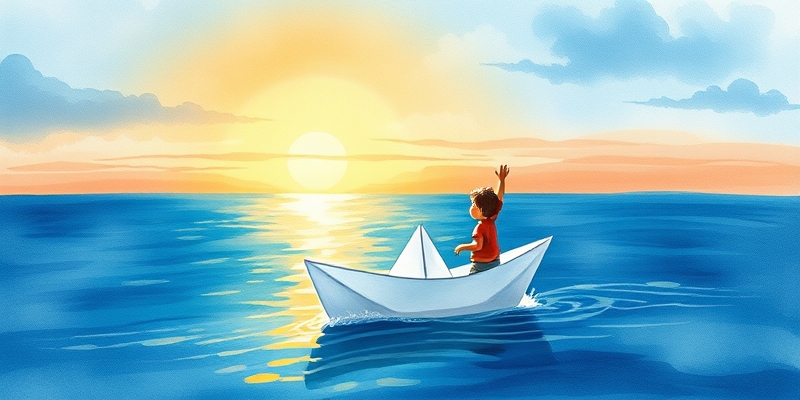
The ship was fine. It wasn't afraid. Because it knew: somewhere out there, far away, on a bridge across a small river, a boy was standing. And he was waiting. And he believed.
One evening a thunderstorm gathered over the sea. Black, black clouds. Thunder. The little paper boat swayed on the high waves and almost capsized. Water began to seep into it. The paper began to crease. And at that moment — from somewhere under the water — a wise old turtle swam up.
"Hold on," he said quietly. "I'll support you.".
The turtle put up its round green shell. The boat climbed onto it as if onto an island. A storm roared past. And when the sun peeked out, the turtle gently lowered it back into the water.
"Thank you," the boat whispered.
"You're welcome," the turtle nodded. "The sea helps those who sail with a dream. Remember that.".
Months passed. Autumn passed. Winter passed. Stepanko often thought of his boat. Sometimes he would come to the bridge, look at the water, and whisper:
"How are you? Are you okay?"
The water was silent. It just gently lapping against the shore.
And then spring came. And one warm April morning, Stepanko went out to the river - and gasped.
Near the bridge, clinging to the roots of a willow tree, a wet, wet piece of paper swayed. Already completely shriveled. Already without a sail. No longer a ship. Just a piece of paper.
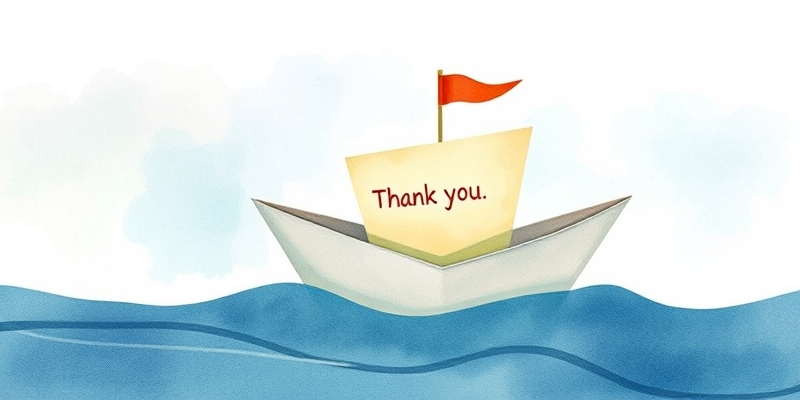
Stepanko carefully pulled it out of the water. He unfolded it in his palm. And he saw — thin lines. Letters. Blurred, but still legible. Someone wrote in a crooked, childlike handwriting:
«"Thank you for the trip. I saw everything you dreamed of. The sea is real. It's even more beautiful than in the pictures.".
Stepanko stood on the bridge and cried. Quietly, quietly. Not from sadness. From that great joy that adults forget, but children still remember.
He carefully wrapped the piece of paper in a handkerchief, brought it home, and placed it between the pages of his favorite book, where the picture of the sea was.
Years passed. Stepanko grew up. He became a sailor. He sailed a lot, saw a lot. But sometimes, when his ship was sailing on the vast waters and there was only boundless blue around, Stepan suddenly smiled to himself. He remembered the little paper boat. And his promise.
He understood a very simple thing. Toys, dreams, even little paper boats - they too have a soul. They grow with us. And when we let them go with love, they return - wiser than they went. They will bring us stories from a long journey. And a little bit of our own childhood faith back.
And isn't it the same with people? We also need to know how to let go of those we love - into their journeys, into their adult lives, into their seas. Because everything good, let go with faith, returns to us.
✨ Those we let go with love, return to us wiser ✨