
⏱ ~6 min reading
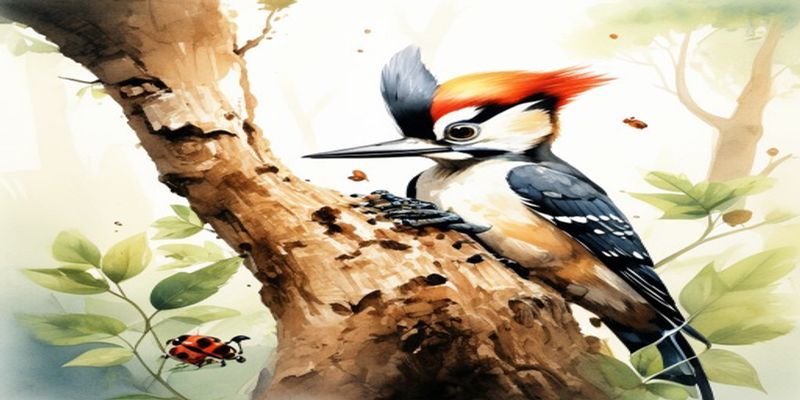
In an old, old forest, where the pines reached the clouds and the oaks still remembered their great-grandfather's great-grandfather, there lived a woodpecker named Tuk-Tuk. He had a red head, a black-and-white back, a strong beak, and a very businesslike character.
Every morning, as soon as the sun washed the sky, Tuk-Tuk would already be sitting on the trunk. Not on a branch — but on the trunk, clinging tightly to the cracks in the bark with his paws. And he would begin his work.
«"Knock-knock-knock-knock-knock! Knock-knock-knock!»
The pecker was tapping so fast that my eyes couldn't keep up. Its tapping echoed through the forest—loud, clear, rhythmic. Like a big clock that had decided it was time to wake up.
And with this rhythm of his, everyone wasn't very happy.
"Who does that?!" Mrs. Soroka was indignant. "I just closed my eyes after a night flight, and he's like, knock-knock! My head's going to explode!"
"My baby is crying," complained the mother Squirrel, looking out of the hollow with the baby in her arms. "Tiny, tiny, just fall asleep - and here on you - a concert. No respect.".
"Oh, and this neighbor is not easy," sighed the Hare in his bush. "And loud, and early. How do they let such people into a decent forest?"
The animals chattered. Some flew up to the woodpecker, some called from below:
"Tuk-Tuk! Could you be a little quieter?"
— Knock-knock, sleep longer!
— Tuk-Tuk, what do you have, don't you have anything else to do?
The woodpecker would stop for a moment, turn his red head, and look at his neighbors with a calm, intelligent eye. Then he would nod politely. And again, «knock-knock-knock-knock.» He couldn’t help it. It was his job. It was what he woke up for.
"What a proud one," the Magpie grumbled and flew away.
Thus passed week after week. The animals were angry, the woodpecker was knocking, the forest was noisy - and it would have been like this forever, if one misfortune had not happened.
Across the clearing where the squirrels were playing, an old alder tree grew. It had stood there since time immemorial. Everyone knew its silvery bark—the older animals leaned against the trunk when they were tired, the little ones played among its roots as if they were among furniture. The alder was their own, their home.
And then one morning the Hare noticed: something was wrong.
The alder leaves hung down, somewhat yellow and limp—and it wasn't even summer, it didn't even smell like autumn. The bark was blackened with spots. The branches drooped as if tired.
"Our alder is sick," said Magpie worriedly. "Oh, seriously sick.".
The animals gathered. The Old Fox sniffed the bark, the wise Marten walked around the tree, the Hare tapped the roots with his paw. Everyone was worried.
"What should we do?" asked the Squirrel. "We don't know how to cure trees.".
"I know," someone said from above.
Everyone raised their heads. Tuk-Tuk was sitting on a nearby pine tree. The woodpecker tilted his head to one side, examined the alder tree carefully—with a doctor's gaze—and began to fly around its trunk one by one, looking closely.
"Inside," he said quietly. "There are bark beetles inside. Little black beetles. They've settled under the bark and are eating the heart of the tree. If they're not taken out, the alder will die in two weeks.".
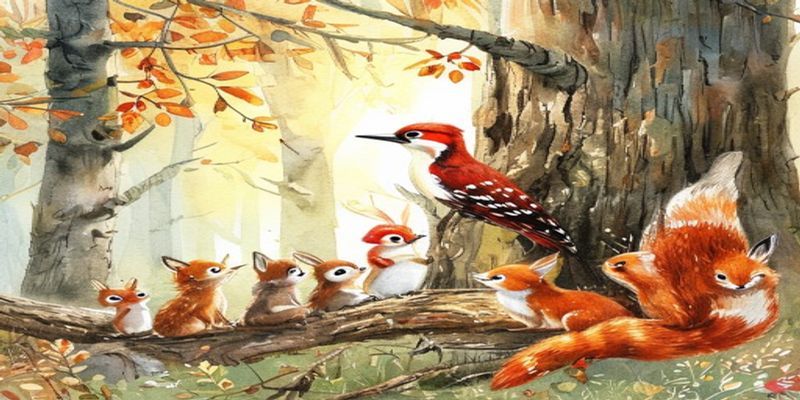
The animals were silent. It was scary to hear.
“Can you… take it out?” Squirrel asked cautiously.
"I can," Tuk-Tuk nodded. "But it's long. And it'll be loud. Very loud.".
The magpie grimaced—she was used to being indignant. But then she suddenly sat down calmly and nodded:
"Knock, Knock-Knock. Knock as much as you need.".
The woodpecker sat on the trunk of an alder tree. He put his ear to it - yes, even birds can listen to a tree. Then he tried his beak on one point. And he began.
«"Here. Here. Knock knock Here.".
But now it sounded different. Now it was not the random rhythms of the morning - but the doctor's precise, careful work. He did not knock hard, where necessary - more softly; where necessary - more strongly. He went around the trunk in a circle, listened, found where the bugs were buzzing under the bark, and made a small hole.
An hour later, the first bark beetle flew out from under the bark—black, shiny, unpleasant. The woodpecker caught it in its beak and threw it away. Then another one. And another and another.
This lasted all day.
The animals sat below and were not annoyed by the noise. The squirrels fell silent. The hare sat on a root and looked with wide eyes. The magpie even brought Tuk-Tuk a berry to help him.
"Thank you," said the woodpecker and went back to work.
The second day. The third. For a whole week, Tuk-Tuk pounded on the alder. He lost weight, his head was getting tired, but he didn't stop. Because he knew that if he stopped now, the bark beetles would crawl out again.
On the seventh day, he flew off the trunk, sat on a nearby branch, and wiped his feather with his beak.
"It's done," he said. "I got everyone out.".
The animals raised their heads. And indeed, the bark no longer emitted that terrible, muffled hum. The alder stood as still as a convalescent.
Another week passed. And a miracle happened. The bark on the alder tree began to lighten. The black spots were fading. The leaves straightened out, turning a rich green. The branches rose upward, as if the tree had stretched after an illness.
The animals came to Tuk-Tuk in a whole forest. Old Marten brought a nut. Squirrel - a pine cone. Hare - a bunch of clover. Even Magpie did not see anything - she stood nearby and was silent, which was a rarity for her.
"Tuk-Tuk," said Mother Squirrel and bowed to him with her wings. "Forgive us. We thought you were just noisy. And you are a doctor.".
"It's not a noise," Tuk-Tuk answered softly. "I'm the one who heals trees. I can't do anything else - my voice is in my beak. If I'm silent - someone is sick.".
Everyone fell silent. Each thought about something of his own. The Hare thought that perhaps his loud stomping at night was not for harm either, but so that his comrades would hear that he was alive. The Squirrel thought that her talkativeness was also work: it was how she conveyed the news. The Magpie—well, the Magpie thought for the first time in a long time.
From that day on, no one in the forest complained about the woodpecker anymore. In the morning, when Tuk-Tuk began his work, the animals woke up and listened to his rhythms, like a lullaby for a new shift. "Tuk-tuk-tuk-tuk." This is our doctor. This is our forest. This is our home.
And the alder tree itself stood green, green, and under its roots the squirrels were playing again. Because when the forest has its doctor, the forest lives.
✨ Not every sound that bothers us is bad: sometimes it's a doctor who saves our forest ✨