
⏱ ~6 min reading
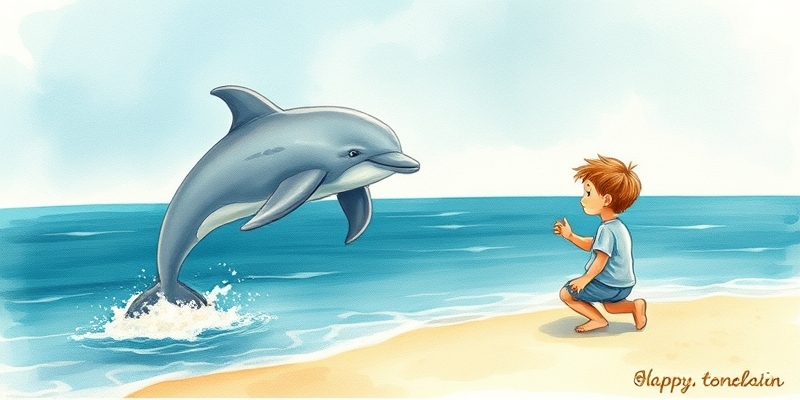
In the warm, warm sea, where the water was as clear as glass and smelled of salt and seaweed, there lived a little dolphin. He was called Briskal, because when he jumped over the wave, he always splashed silver sparkles of water around him, which fell back into the sea with a quiet "plash-plash.".
Briscal was an unusual dolphin. His other relatives liked to chase fish, play with bubbles, or nap under the warm waves. But Briscal collected postcards.
Yes, real paper postcards. He found them everywhere. Sometimes a wave would wash a wet piece of paper ashore that had fallen from a sailor's pocket. Sometimes a storm would throw old postcards from distant lands out of a sunken mailbox. Sometimes children on the beach would throw their drawings into the sea - and they would float on the water and travel until Briskal noticed them.
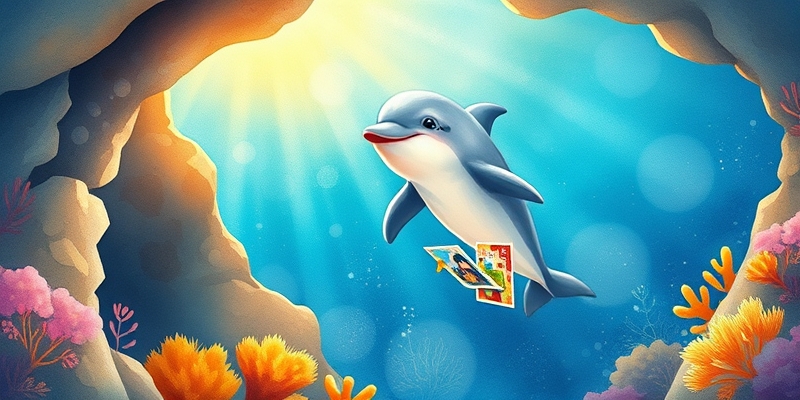
He hid all his treasures in a secret place under a large coral tree, in a cozy hollow where no one would look. There he had a whole collection: a postcard with a picture of mountains, on which it was written "Greetings from the Carpathians"; a wet piece of paper with a yellow sun drawn on it; a postcard from distant Lisbon with blue tiles; a child's drawing of a cat holding a fish in its paws.
Every evening, when the sea grew still and purple, and the sun set behind the distant horizon in a golden slice, Briskal would swim to his hiding place, carefully take out one card at a time, and examine it. He stroked them with his fin, whispered to them, imagined the people who had written them. The wise old octopus, who lived in a nearby cave, would only wave his tentacles and mutter to himself:
"A strange dolphin. All the normal fish chase fish, but this one chases pieces of paper.".
"Who are you," Briskal hissed at the postcard from the mountains, "who sent you? Where did you sail? You must have high snowy peaks there? And do they smell like cold water?"
The postcards were silent. But it seemed to Bryskal that they were responding - with the quiet rustling of paper under water. It seemed to him that each postcard had its own smell: from the Lisbon one - warm brick and oranges, from the Carpathian one - resin and pine needles, from the child's drawing - paints and a child's hand.
Then one morning, when the storm had just subsided over the sea, Briskal swam out to his favorite shallows. The waves were still a little rough. The sand on the shore was mixed with seaweed and pieces of shells. And suddenly, in the midst of it all, he saw her. A new postcard.
It was special. Colorful. It showed a boy—red-haired, freckled, in blue shorts—and his little dog, small, curly, with a sticking out tongue. At the bottom, in block letters, it said: "Me and Ryzhik. Summer by the sea.".
Bryskal jumped with happiness. He carefully picked up the postcard in his mouth, without crumpling the edges, and was about to rush to the hiding place when he suddenly heard a sound. Very quiet, but very sad. Someone was crying.
The dolphin turned his head. On the shore, right by the water, sat a little boy. Red-haired, freckled, in blue shorts. A curly-haired dog was jumping on three legs nearby - he was sniffing something in the sand, as if looking for it. The boy was crying quietly, into his fist.
"I lost it," he whispered to himself. "The most expensive drawing. Mom kept it. It's me and Ryzhik..."
Briskal froze. He looked at the card in his mouth. Then at the boy. Then at the card again.
His chest felt tight. It was his new postcard. The newest in the collection. It took him an hour to gather his strength to pull it out from under the seaweed. No one but him had seen it. It should have been lying in the hiding place with the others—in the best place.
But the boy was crying. And the hedgehog jumped next to him, pressed his wet nose against him and could not console him in any way.
Briscal took one deep breath. Then another. And then, without hesitating any longer, he swam to shore.
The boy raised his head. At first he was frightened - he saw a silver back in the waves. Then he saw something colored in the dolphin's mouth.
“Is this… is this my postcard?” he whispered.
Bryskal carefully released the piece of paper onto the wet sand at his feet. And swam back a little so as not to scare him.
The boy grabbed the card with both hands. Tears still glistened on his cheeks, but his eyes were already laughing.
"It's her! It's me and Ryzhik! Thank you, little dolphin, thank you!" His voice rang with such great joy that the seagulls above the beach fell silent and listened.
He jumped into the water up to his knees, hugged Bryskal as tightly as he could — by his slippery wet head — and kissed him on the face. And Ryzhik, not understanding what was happening, barked happily and also jumped in the waves, splashing salt water around him. The boy whispered softly in the dolphin's ear:
"I'll never forget you. Honestly, honestly. You're the sea's best friend.".
When Briskal returned home — deep down, to his coral — he suddenly noticed that he felt light. Very, very light. It was as if the water had become clearer and the sun's rays had become warmer. A small joy that he had never known before was bubbling in his heart. Not the joy that comes from finding a new postcard. But something completely different. Warm, like a child's hug.
In the evening, he swam to the cache, took out his collection and looked at it for a long time. And then he understood. The postcards that were in the cache were just pieces of paper. And the postcard that he gave away became real. Because it brought joy to someone.
From that day on, Briscal handed out postcards. Each one to someone who needed it. To a sailor who was homesick, he brought a postcard with a picture of a house under a willow tree - and the grown man on deck leaned his head against the side and smiled softly. To a girl who had lost her childhood album, he brought a postcard with a yellow sun drawn on it - and she called out to him from the shore for a long time: "Little dolphin, you are a miracle!". To an old fisherman who remembered his distant youth, Briscal brought a postcard of Lisbon with blue tiles - and the grandfather stood for a long time on the pier with that piece of paper in his trembling fingers, because it was there, in Lisbon, that he had once seen his grandmother young.
And the most amazing thing: the collection did not decrease. On the contrary. Every day the sea brought new and new pieces of paper - as if it knew that now Bryskal had a wide, wide heart and there would be enough room for the whole world. Because generosity, as he understood, is such a source: the more you share from it, the more it flows from it.
✨ Generosity is a source that never runs dry: when you share, the treasure becomes greater ✨