
⏱ ~5 min reading
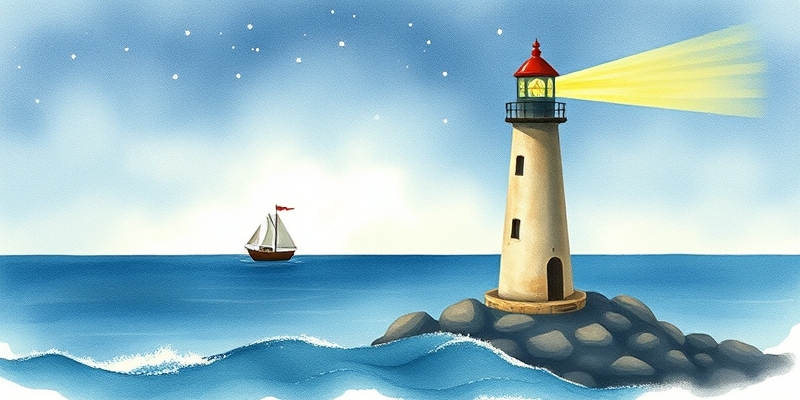
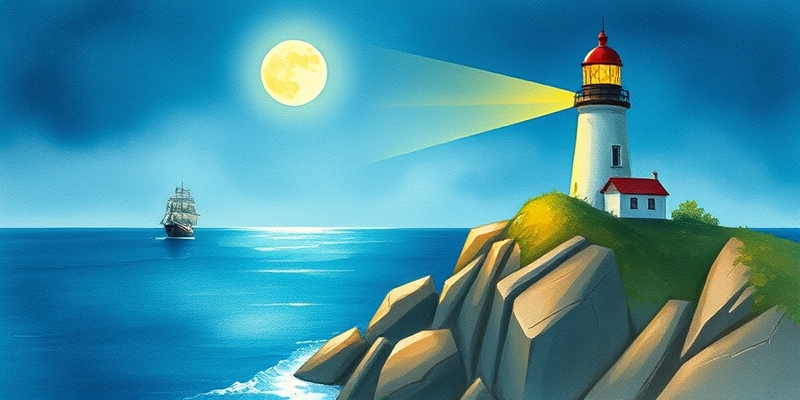
On a high, high cliff, where the sea meets the sky, stood an old lighthouse. White, with a red dome-cap, with a narrow window at the top and stone steps inside. His name was Yanko. Yes, the lighthouse had a name - because when something lives for a hundred years, it inevitably has a name, a character, and a heart.
Yanko was not like other lighthouses on the coast. All ordinary lighthouses shone evenly: it lit up - went out, lit up - went out. And Yanko knew how to wave. Yes, yes, with his light, like a kitten's tail. Now he smeared a golden stripe on the water in one direction, then in the other. Now he drew a round loop on the waves. Now he waved lightly, like a palm in farewell.
The sailors knew it by this feature. Even from a distance, before they could see the rock, they recognized it:
— Yanko is working! The house is close.
When night fell over the sea and the water became black, like wet stones, the ships cautiously approached the shore. Somewhere in the fog - anxious. The rocks are sharp, the shallows are treacherous. And then, in the midst of the darkness - a warm golden wave. Yanko waved:
"I'm here! I'm here! Don't be afraid, I'm with you!"
The ships were recognized. They returned home. Not one had crashed on the rocks in a hundred years.
Yanko knew all the captains. The old captain Bogdan with a red beard that smelled of a pipe and the sea. The young captain Yaryna, who went to sea for the first time on her father's ship and was afraid to frown so that the sailors would see: she was tough. The boy-cabin Samiylo, who was afraid of fog, but dreamed of becoming a navigator one day. The old fisherman Marta, who went out to fish every day at dawn and always looked at the lighthouse instead of an alarm clock. The children from the coastal village who ran along the rocky path to the foot and threw Yanko small cornflowers that they found among the moss.
Yanko silently nodded to each of them with his golden wave. He recognized each one by their swimming style — some were confident, some cautious, some in a hurry, some enchanted by the sunset. The lighthouse on the rock knows more than it seems.
This summer, Samiylo was just sailing on a small boat, the Chaika. And he got caught in a fog. Thick, milky-white, so thick that you couldn't see your own hand on the steering wheel. The guy's fingers trembled. Captain Bohdan was below, checking the engine. Samiylo stood alone on the deck and didn't know where to sail.
"Yanku," he whispered into the fog. "Help me. I can't see the shore.".
And then there was a flash through the milky wall. One wave. Then another. Yanko waved—with a warm, gentle, golden tail of light. Samiylo saw. His heart beat more evenly. He turned the wheel in the direction of the wave—and the Chaika went where the lighthouse called.
Half an hour later, the fog thinned a little, and the boy could already see the rock on which Yanko stood. The lighthouse waved even more warmly — as if saying: "See? I told you, I'm with you.".
When the Chaika entered a safe bay, Samiylo took off his hat and raised his head. Yanko shone especially brightly.
"Thank you," the boy said quietly. "You probably saved my life today.".
Yanko waved again. Modestly, in a homely way. As if saying: "What are you doing? I'm just doing my thing.".
That same autumn, Yanko met the little sailor separately. Samiylo came to the lighthouse on foot - along a path through the rocks, with a bouquet of wildflowers and a round warm pie that his mother had wrapped in a towel. On the way, the boy stopped, looked at the seagulls soaring over the water, and thought about what to say to the lighthouse. Words were not enough - words always seemed too small for what was in his heart.
When he arrived, he placed the bouquet near the stone wall. He leaned his hand against it—the wall was warm from the sun. He sat down on a stone at the foot and spoke as if to an older friend.
"Yanku," he said. "I've been thinking about you a lot. You don't fly, you don't swim, nothing like that. You just stand on a rock and wave. And how many times have you helped someone?".
Yanko was silent. Lighthouses cannot speak with words—they speak with light. But Samiylo heard him in a different way—with his heart.
"I understand now," said the boy. "You don't have to be big to help. You just have to do what you know how to do. Wag your little tail.".
Yanko quietly lit up more brightly. It seemed to get warmer inside its old stone walls.
When Samiylo returned home, he noticed that his mother was standing at the gate, waiting. Tired after a hard day. He ran up, hugged her, and smiled broadly.
"Hi, Mom. I've missed you all week.".
Mom smiled back, and her fatigue seemed to slip off her shoulders like an old scarf.
“My child,” she said, “it is good that you have come.”.
Samiylo suddenly thought: here he is — a lighthouse too. A small one, but a lighthouse. His smile is like that wag of his tail. A small gesture — and mommy breathes easier.
At home, he wrote in a notebook in small handwriting: "I will wave too. Because someone is looking for shore in the fog.".
And Yanko continues to stand on the rock. For a hundred and twenty years. Maybe more. He knows all the captains, all the young men, all the stories. Thousands of stories have passed through him - and in each one he simply waved. Not with a miracle, not with a fairy tale. Just with a warm little wave.
If you ever sail past a rocky coast in the evening and see a golden light waving at you from above, know that it's Yanko. Wave back. He sees you. And he's happy.
And if you think you're too small to help, remember the old lighthouse. Small signs are big shores. Keep waving. Someone sees you. And someone is already grateful to you.
✨ Small signs of attention are a big support for those who are swimming in the dark ✨