
⏱ ~6 min reading
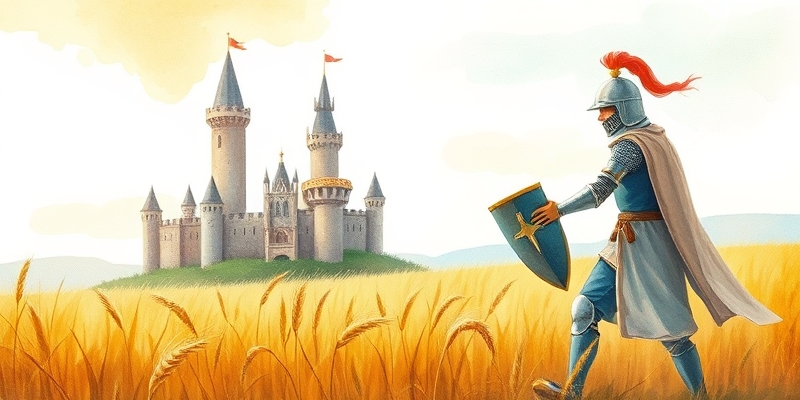
In the kingdom above the blue hills lived a knight named Ivan. Tall, broad-shouldered, with kind wrinkles near his eyes. He had a sword - a beautiful, sharp one, with a carved hilt. But more often than the sword, other things lay in his hands: a scythe, a sickle, a wooden plow handle.
Because the knight Ivan — to the surprise of the entire kingdom — grew wheat.
Instead of going to knightly tournaments, where swords rang against shields and the stands roared "Glory!" - he would get up with the sun, harness his bay horse Kashtan and go to the field. The horse neighed, pulling the plow, and behind the plow a warm, black, fragrant furrow remained. It smelled of wet earth, earthworms and grass rhizomes. Ivan followed, holding the plow handles tightly, and his blue armor hung on a hook in the barn - he only wore them on holidays.
The other knights were surprised. And some even mocked.
"Ivan," they told him, "the knightly cause is with the sword. Victories. Glory. And you are digging in the ground. You are a knight, not a peasant.".
Ivan listened calmly. He wiped the sweat from his forehead with his shirt sleeve and answered:
"I am a knight. A knight of bread. Isn't it a knight's job to feed those he protects?"
"That's different!" they laughed. "Let the peasants sow. And the knight fights.".
"He who sows also fights," Ivan said quietly. "Only with hunger.".
They waved their hands and went to the tournament. And Ivan was smiling.
In the spring, he would put golden grain in the ground. In the summer, he would make sure that weeds didn't grow, that the rains would water the field in time, that the hail cloud would pass by. And in the fall, when the wheat stood like a wall—golden, tall, with heavy spikelets—Ivan would take a sickle and reap.
He didn't sell all the grain. He stored most of it in large wooden bins in the barn. "Just in case," he thought. "The earth is like a mother: generous, yet wayward. Sometimes it will give a lot, and sometimes nothing.".
For several years it went on like this. Ivan sowed and stored grain in the bins. Colorful flags fluttered above the castle on the hill, knightly horses neighed in the stables, tournaments thundered in the stands. And Ivan was in the field.
Until one year something went wrong.
The winter was long, without snow. The spring was cold, with night frosts. The summer was hot, without rain. The fields dried up, the grain did not sprout. The corn stood yellow, as if made of paper. The orchards did not produce apples. The rivers became shallow.
A famine struck the kingdom.
Children begged for bread. Mothers cried. Old people picked the last crumbs from the boxes with their thin hands. The castle became quiet. The flags still fluttered, but no longer cheerfully.
The king summoned the knights. They gathered in the throne room, in shining armor, with beautiful swords. The king said:
"My knights. The people are starving. What can we do?"
The knights were silent. One said:

"Your Majesty, we know how to fight. We could defeat any enemy. But hunger cannot be fought with the sword.".
"I can go to distant lands, look for grain," said the second. "But by the time we get there, it will be too late.".
The king lowered his head. Then Ivan slowly entered, wearing a simple shirt and with dirt on his boots.
"Your Majesty," he said, "I have a barn full of grain. I've been storing it for years. Enough to last the whole kingdom until the next harvest.".
The hall became very quiet. The knights, who had been mocking him yesterday, looked at Ivan with different eyes.
Ivan brought grain. From his barn, cart after cart, sacks were being pulled. In the towns and villages, the ovens were smoking again. There was a smell of warm bread—the same smell that you can’t confuse with anything else: a little yeast, a little burnt crust, a little summer in the grain. The children began to smile again. The mothers stopped crying. The old people ate a thinly sliced slice, sprinkled with salt, and whispered, «Thank you, Lord.» And the little boys ran around the ovens with crumbs on their cheeks and laughed.
When everyone had eaten, the king called Ivan into the castle. He hugged the knight and said:
"Ivan, you saved the kingdom. I want to make you a military leader. You deserve it.".
Ivan thought. He looked out the window - there, in the distance, his bay Chestnut was grazing in the meadow.
"Thank you, Your Majesty," he said. "But I am a knight of bread, not of the sword. Let me continue to sow. That is my business. I am in my place in it.".
The king understood. He thought and said:
"Then I will do it differently. I will give you the largest field in the kingdom. And every knight from this day forward will be obliged to plant a tree and harvest it once a year. Even if it is small, it is his own.".
And so it happened. The knights learned from Ivan. One planted an apple orchard - and in the fall brought the queen a basket of yellow-sided ranets. The second planted a walnut grove - and ten years later the sun shone there through the green lace of leaves. The third took up grapes - and his daughters gathered heavy clusters into wicker baskets. The fourth bred bees - and four types of honey appeared in the kingdom. Each had his own business - except for the sword. And there was never again hunger in the kingdom.
And once a neighbor's little son, named Petryk, ran to Ivan in the field and asked:
"Uncle Ivan, can I come with you? I also want to be a bread knight.".
Ivan squatted down, placed his calloused hand on the boy's head, and said:
"You can, son. Just know: a knight of bread is not one who throws grain with one hand. He is one who protects the earth like a mother. Get on Chestnut, I will take you on a ride in the furrow.".
And Ivan followed the plow until he was very old. There were calluses on his hands, earth in his boots, and peace in his heart. Because he knew: true knightly honor is when the barn is full of grain, and warm bread is on people's tables. Because any work can be knightly. If it is done with honor.
✨ A true knightly honor is to feed your own; any work is knightly if it is done with honor ✨